
For supply chain teams, inefficiency does not always come from major system failures or poor planning. It can also build up through small, repetitive tasks: transferring figures between spreadsheets, checking order details, reformatting reports and manually reconciling information across systems.
These tasks consume time that planners, warehouse teams and operations managers could spend investigating exceptions, resolving delays and making better decisions.
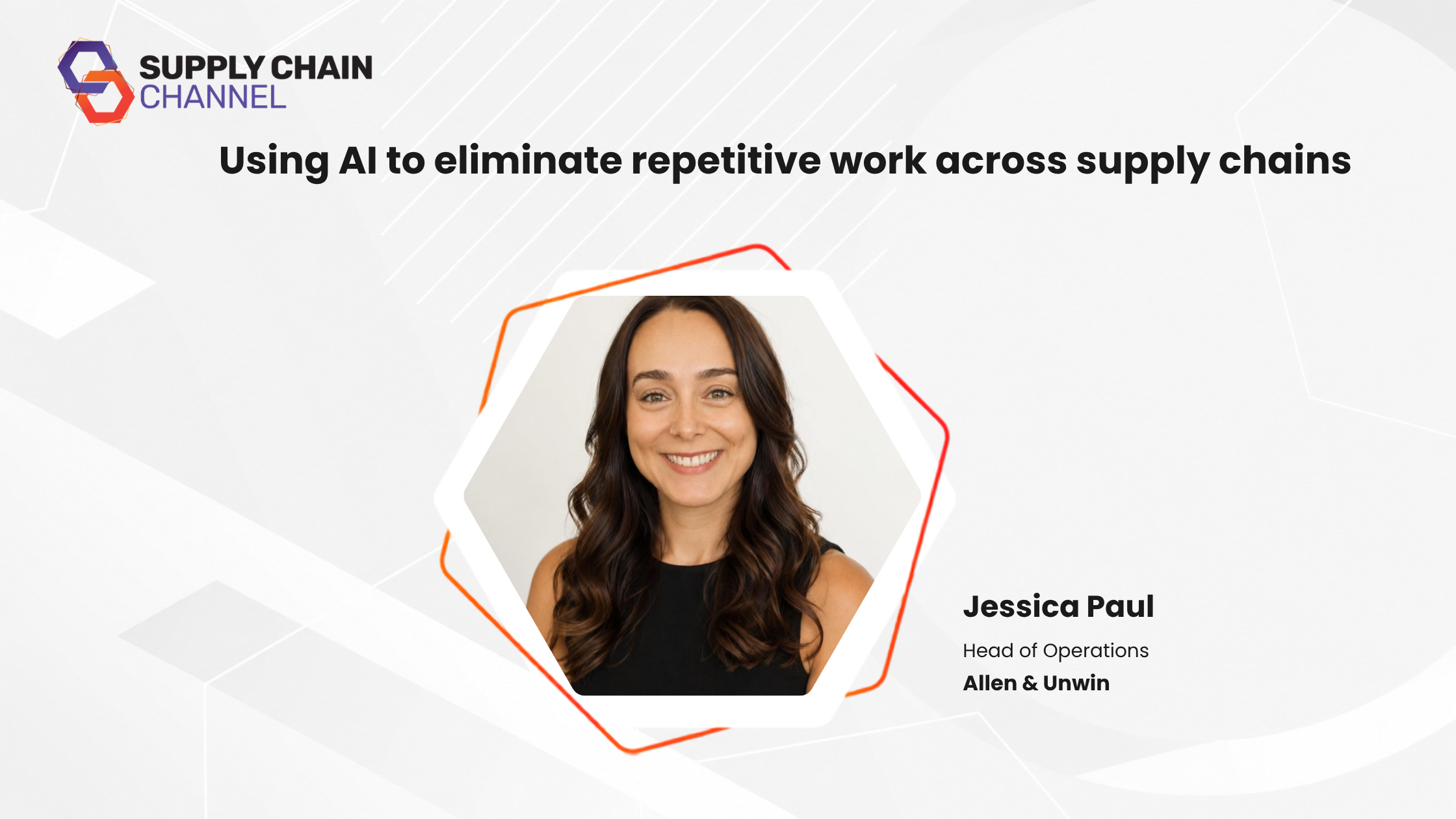
At the Supply Chain Week event, Jessica Paul, Head of Operations at Allen & Unwin, shared a practical approach to AI adoption that starts with a simple question: which tasks would people most like to stop doing?
Her “Kill this task” initiative invites employees to identify repetitive work they find frustrating, then works with them to find ways to automate it. Rather than starting with a new technology and searching for a use case, Paul starts with the problem employees already want to solve.
For supply chain organisations under pressure to improve productivity without compromising service, that approach offers a useful lesson: automation is more likely to deliver value when it addresses a real operational bottleneck.
Start with the work that slows people down
Paul’s idea grew from listening to employees complain about repetitive tasks. She introduced a physical whiteboard in the office and a virtual version for remote workers, where people could list the work they wanted to eliminate.
The tasks vary in scale. Some can be completed in an hour; others require months of work to resolve. What matters is that employees can identify a process they know is frustrating or inefficient.
The same principle applies to supply chain operations. A planner might spend hours consolidating demand data from different files. A warehouse administrator might repeatedly enter delivery details into separate systems. A customer service team might manually compile order status updates before responding to enquiries.
Individually, these tasks may appear minor. Across a team, however, they can absorb considerable time and introduce opportunities for errors, duplicated work and delays.
In planning and fulfilment, the consequences can extend beyond administrative productivity.
Incorrectly transferred figures can undermine reporting, while delayed updates can leave teams working with outdated information. Automation will not solve every data or process problem, but it can help reduce avoidable manual work when the underlying workflow is suitable.
Paul’s approach also gives employees a direct role in identifying where that improvement should begin.
“If I walk up to someone and tell them AI will change how they work, that’s my idea and they’ve got every right to be sceptical,” she says. “If they write their own annoying task on the whiteboard, it’s their problem and it’s their win when it’s gone.”
Employee ownership can reduce resistance
Introducing AI into supply chain operations is not simply a technical exercise. Changes to planning, procurement, warehousing and customer service processes can affect how people perform their jobs and how much control they feel they have over their work.
Employees may be concerned that automation will replace their roles, add another system to manage or create more work when its outputs need checking.
Paul’s method addresses that resistance by allowing employees to define the problem themselves. They do not need to know how to automate a task or which technology to use. They only need to explain what they do, why it is frustrating and what a better outcome would look like.
That distinction matters in operational environments, where frontline employees often understand the practical difficulties of a process better than the people selecting or implementing the technology.
A warehouse employee may know exactly where duplicate data entry occurs. A demand planner may understand why a weekly report takes hours to reconcile. A transport coordinator may recognise the manual steps that make it difficult to provide timely updates.
Giving those employees a voice can help organisations identify more relevant automation opportunities and build confidence in the changes that follow.
Use AI for repetitive work, not operational judgement
Paul’s guiding principle is to use AI for the boring stuff.
She draws a line between administrative tasks that follow repeatable rules and work that depends on professional judgement, relationships or creativity. At Allen & Unwin, that means keeping AI away from decisions such as what to publish, editing, cover design and relationships with authors and agents, while exploring its potential for routine administration.
In supply chains, the equivalent distinction is between reducing the manual effort involved in handling information and delegating decisions that require context and accountability.
AI may help organise incoming information, extract data from documents, prepare routine reports or assist with recurring administrative workflows. These applications can free employees to focus on exceptions, supplier issues, customer needs and decisions that require experience.
But automating a task does not automatically make the result reliable. Supply chain teams still need to validate outputs, protect sensitive information and understand how errors could affect downstream decisions. A tool that processes information quickly is of limited value if it produces inaccurate figures or obscures the source of an error.
The starting point, therefore, is not to automate every task that can be automated. It is to identify work that is repetitive, governed by reasonably clear rules and does not require substantial judgement at every step.
Better instructions start with a clear problem
Paul uses the BRIEF method to help people work more effectively with AI. The approach asks users to provide background on the problem, supply the real materials needed, explain their intended outcome, encourage the AI to ask questions and follow up on the information it
requests.
The emphasis on context is particularly relevant to supply chain work, where data can come from multiple systems and documents and where apparently similar tasks may have different requirements.
For example, asking an AI tool to summarise an operational report is different from asking it to reconcile inventory figures across sources. The latter requires clarity about which files to use, how the figures are defined and how discrepancies should be treated.
Paul encourages users to give AI the actual material it needs rather than relying on vague descriptions. She also recommends allowing it to ask questions before producing an answer, helping identify missing information before it leads to an unsuitable result.
For supply chain teams, this approach reinforces a basic requirement: define the process and desired outcome before choosing the technology. AI cannot reliably compensate for unclear instructions, inconsistent source data or a workflow nobody has properly mapped.
Build a repeatable solution, not another manual step
Paul sees a further opportunity when employees move beyond asking AI to perform the same task repeatedly and instead use it to help build a reusable tool or script.
The distinction is between using AI as an assistant every time a task arises and using it to create a solution that can handle a recurring process with less intervention.
In supply chain environments, that could mean creating a repeatable workflow for formatting reports, extracting specified information from documents or preparing routine data for review. The potential benefit is not simply faster output. It is reducing the need to repeat the same manual steps each time the process runs.
However, a reusable tool still needs testing, maintenance and clear ownership. Processes change, source systems are updated and exceptions arise. Organisations need to know who checks the output and what happens when the tool encounters information it cannot handle correctly.
Paul’s own role is to work alongside employees rather than hand over a tool and leave them to figure it out. She describes the approach as “sitting in the mud” with people, helping them solve the immediate problem while building their confidence to tackle the next one themselves.
That support is important if automation is to become part of everyday operations rather than remain a collection of isolated experiments.
Data skills remain essential
For Paul, the growing use of AI makes data literacy more important, not less.
“I think data skills are going to matter more than AI skills,” she says.
Employees need to understand where data comes from, how systems use it and why figures may not align. This is especially important in supply chains, where decisions depend on information moving between suppliers, planning systems, warehouses, transport providers and customers.
Automating the transfer of poor-quality data does not fix the underlying problem. It can simply make the same mistake happen faster and at greater scale.
Paul also stresses the need for clear guidance on data handling. She has turned off data sharing on her AI tools, but recognises that this setting does not mean every type of information is automatically safe to enter. Organisations must establish rules for sensitive commercial, employee, supplier and customer data, and ensure employees understand those rules.
For supply chain leaders, successful AI adoption therefore requires more than access to tools. It depends on sound processes, reliable information, appropriate safeguards and employees who understand both the technology’s potential and its limits.
Also read: Featured Leader: Elton Brown on the human side of AI-driven supply chain transformation
Start with the task, not the technology
Paul’s approach offers a practical starting point for organisations exploring AI amid ongoing pressure to improve productivity, service and operational resilience.
Rather than beginning with a broad automation programme, leaders can ask employees to identify the repetitive tasks that take time away from more valuable work. They can then assess which tasks are suitable for automation, test solutions with the people who use them and measure whether the changes improve the process.
The benefits will vary. Some tasks may be better addressed through a simpler software feature or process redesign than through AI. Others may require better data integration or clearer responsibilities before automation makes sense.
The objective is not to use AI everywhere. It is to remove avoidable friction from the work that keeps operations moving.
For supply chain teams, that could mean less time transferring data and preparing routine reports, and more time responding to disruptions, investigating exceptions and improving service to customers.
The first step may be simpler than launching another technology initiative: ask people which task they would most like to stop doing.
Step into the spotlight: Become a Featured Leader on the Supply Chain Channel.

Yvette is a Content Producer at Akolade, producing stories for Supply Chain Channel, an Australian learning ecosystem created to address the need for information, networking, case studies, and empowerment for everyone in the supply chain sector.